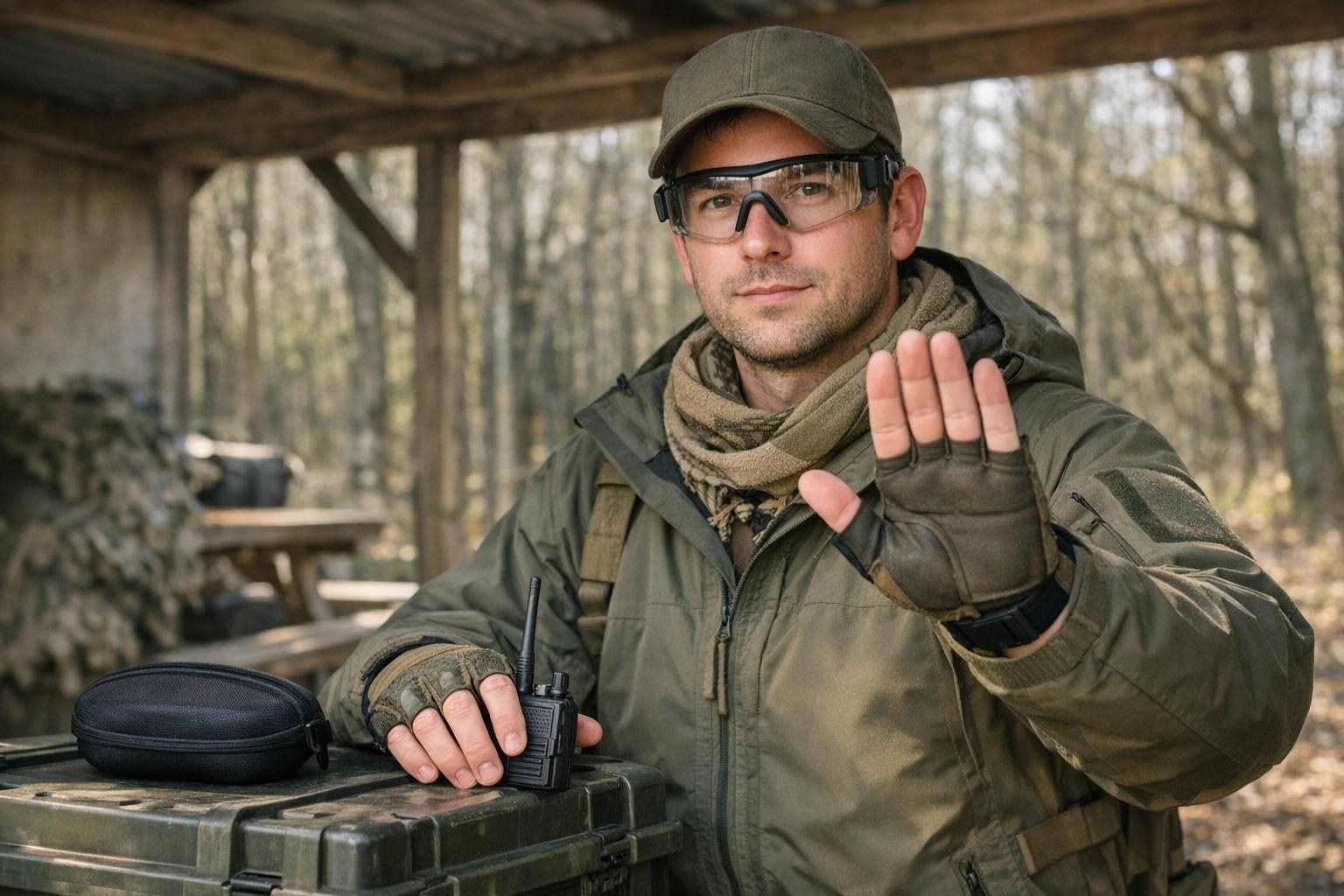

The typical new airsoft player will spend a considerable amount of time finding the best replica, learning about the different batteries and magazines, and even plotting the best route to the field before their first game. All of these choices will impact their game, but none as greatly as confusion over a teammate's gestures. Learning a few simple airsoft field signals can help you to communicate with your teammates in quiet, sometimes hectic situations on the field. Just remember, learning a few simple hand signals does not have to mean learning an entire elaborate code. Simply practicing the few signals that are useful, and making sure that your team uses them in the same way, will be enough.
The first signal arrives before the game starts
Consider a typical first game scenario: You and 3 other teammates are moving through a woodland in a single file, when the player at the front of the line raises a closed fist. You freeze in place, unsure whether he has spotted an enemy, seen something of importance or simply needs you to wait for a moment. A moment later someone whispers a question and the group of you cluster together, losing your advantage of having been quiet.
These pauses in play occur for reasons outside of the first game's scope. Often the confusion will have arisen as a result of a team utilizing similar signals with different meanings. In many cases these signals can be affected by the Field Layout, the local Marshall and even the Field's own local practices. Prior to leaving the Safe Area seek from the Team Leader the demonstration of all previously agreed signals and their subsequent actions.
If you limit your pre-game briefing to the absolute essentials then it doesn't matter how complex or individual the hand signals are. A few simple examples would be to describe how you would like your team to 'stop', 'move off', 'gather together', 'danger', 'contact enemy', 'low batteries/ammunition', 'injured/equipment problem' and 'end of game'. Then in each case ask the player to demonstrate the signal and for the rest of the team to confirm that they have understood it correctly.
Build a small vocabulary you can recognise at a glance
A good signal is one which is visible (even when wearing gloves), clear and simple to imitate. It is also useful to consider whether the signal can be seen by the recipient from behind the sender, from a distance and when the sender is partly crouched over. For example, a raised open hand and a clenched fist may look very similar to some people.
The key to a number of the above 'before you go' points, that relate to a team's communication, is the small number of hand signals that a group can use to control the pace of play and pass information regarding safety. Important signals should be easily distinguishable from those that are used to instruct players to move in different directions, and a signal used to indicate a player's malfunction or injury should prompt a response from other players in the game. Many sites use radio calls and loud verbal safety phrases, which must be stated in the field's briefing, and be adhered to by all players on that site.
Rehearse the meaning and response to the signals. It is not necessary for every player to replicate a gesture in full. A simple acknowledgement, such as a nod or a hand shake, between players to confirm that a message has been received is sufficient.
Match hand signals with radios and equipment habits
Once you've got a set of hand signals which work for you, it's worth noting that the useful approach to communications is not to try to learn a whole load of codes and to try to remember them all. No, instead, what you should do is pick a few simple signals and practice them until you can recognize them. Then, at game time, confirm with the other members of your team how you've decided to use them. That way, you can be sure that everyone is on the same page.
In terms of interference from airsoft equipment, a player's gloves may restrict their fingers when trying to make hand signals. Their goggles, mesh face protection or full-face mask may muffle any spoken words. A radio headset will cover a player's ears, meaning they will be unable to hear their teammate's voice. Also, players with to wear loose slings or dangling cables on their airrifles run the risk of these getting caught in trees etc as they move about the airfield.
The radio should be set to a suitable volume and switched on and off as needed in order to hear surrounding field players and listen for the marshals' instructions. Remember that in many paintball games, communication is restricted in order to make players more aware of their surroundings and players have to resort to a variety of visible signals to communicate with each other.
Use the woodland scenario to test your understanding
The example returns to the three people. The lead person holds up the fist for a stop at a fallen tree trunk. The player is to stop, keep his gun safely pointed in the same direction and look back to see if the person behind him has stopped as well. Once he has confirmed that they have, the lead person then moves to indicate a regrouping point, as opposed to continuing on in a line. From there, the group moves off in an order of their choice as a group, continuing in a single line.
This simple approach to field control can be further exemplified by practicing the basic elements of a 'move and stop' scenario within your practice session before venturing to the main field. This will ensure you have a solid understanding of how to best communicate to your teammates within a woodland scenario, and will also aid in recovery should you become lost from your team members.
Practice your new signals in different parts of your proposed woodland game scenario – including shaded areas, noisy areas such as near a field exit or close to other players, and near the ends of lines of players. Also practice signals at short range and test out how they look at distance. If you find two signals are frequently mis-interpreted, then swap one of them for an alternative signal.
Keep communication safe, courteous and adaptable
Be respectful of other airsoft players by not misusing the airsoft field signals, such as using the emergency stop signal for amusement. Also, avoid mimicking the marshals and do not invent new airsoft field signals. When communication breaks down, remember to remain calm and speak clearly to your teammates to sort out the problem as quickly as possible.
Remember to remain courteous when using a field signal. Refrain from using an emergency signal as a joke, pretend to be a marshal, or use a field signal in a different context that may cause confusion with other players on the field. If another player appears confused with a signal that you have given, reiterate the signal and in quiet tones explain the meaning of the signal. Remember, a new player asking for clarification of a field signal helps the whole group.
If you start playing airsoft, most useful tips are small things. Watching the player in front of you, only passing on information which you are sure the other player understands, acknowledging a message which was important to the other player and admitting when you can no longer see the other player. At the end of the game, discuss which of your hand signals worked and which caused confusion.